A Brief History of Faerûn
Journey through the rise and fall of ancient civilizations, magical catastrophes, divine upheavals, and the events that shaped the modern Forgotten Realms.
 G.R. Vinces6 min read
Welcome to the Forgotten Realms · Reading 8 of 8
Walk long enough through Faerûn and eventually you will find ruins.
A broken tower standing beside a forgotten road.
An abandoned dwarven hall beneath a mountain.
An ancient elven city swallowed by forest.
A magical artifact whose creators disappeared thousands of years ago.
The Forgotten Realms earned its name for a reason.
The civilizations that exist today were built upon the remains of civilizations that came before them. Kingdoms rise, expand, fracture, and disappear. Gods interfere. Magic changes. Entire peoples migrate across the world.
And then someone builds something new on top of the ruins.
To understand Faerûn, you have to understand one simple idea:
The world has been here for a very long time.1
Before the Human Kingdoms
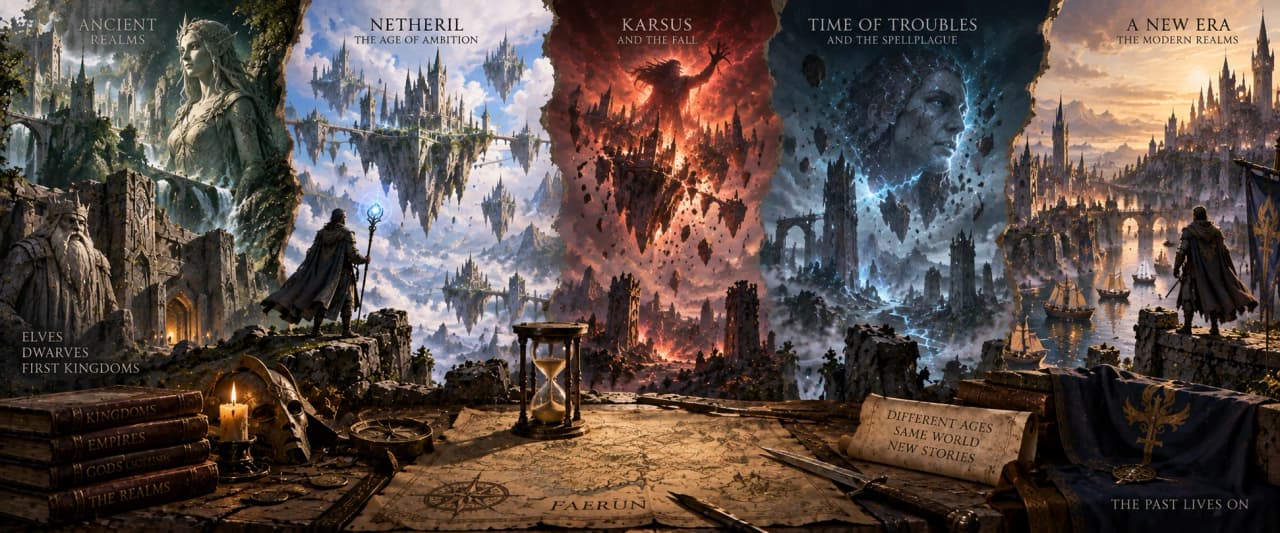
Faerûn’s history stretches back tens of thousands of years.
Long before cities such as Waterdeep, Neverwinter, or Baldur’s Gate existed, other peoples were already building civilizations across the continent.
Ancient elven realms spread across great portions of Faerûn. Dwarven kingdoms carved enormous settlements beneath mountains and established their own powerful realms. Their histories included periods of expansion, alliance, migration, and devastating warfare.1
Some civilizations disappeared.
Others survived in diminished or transformed forms.
And the ruins they left behind became part of the landscape inherited by later peoples.
This pattern would repeat again and again.
The Age of Great Empires
Eventually, human civilizations rose alongside the older realms.
Among the greatest was Netheril.
Netherese arcanists developed magic on a scale almost unimaginable to most modern inhabitants of Faerûn. At the civilization’s height, powerful magic allowed entire settlements—flying enclaves—to rise into the sky.2
For centuries, Netheril became one of the great magical powers of the ancient world.
Then one wizard tried to go further.
His name was Karsus.
In an attempt to wield divine power, Karsus performed an act of magic so extraordinary that its failure contributed to a catastrophe for Netheril. The magic sustaining its flying enclaves failed, and the civilization that had dominated the skies collapsed.3
Some Netherese survived.
Their empire did not.
But Netheril never truly disappeared from Faerûn.
Its ruins remained.
Its magic remained.
Its descendants remained.
And thousands of years later, people were still dealing with what it left behind.
New Kingdoms Rise
The fall of one empire did not end history.
New kingdoms, cities, alliances, and cultures continued to emerge across Faerûn.
Human realms expanded. Elven and dwarven civilizations changed. Trade routes connected distant regions. Cities that would eventually become familiar names grew in power and influence.1
Some kingdoms endured for centuries.
Others vanished quickly.
And throughout all of this, adventurers, rulers, monsters, magical organizations, and religious powers repeatedly altered the course of events.
Faerûn never settled into a permanent political order.
Its map kept changing.
Sometimes because of ordinary war.
Sometimes because of something far stranger.
When the Gods Walked the World
In 1358 DR, Faerûn experienced one of its most famous upheavals: the Time of Troubles.4
The gods were forced from their divine realms and made to walk the mortal world in avatar form.
Divine power was disrupted.
Magic became unpredictable.
Gods fought.
Some died.
Mortals became directly involved in conflicts that normally belonged to the divine.
Eventually the crisis ended, but the pantheon did not emerge unchanged.4
For the people of Faerûn, this wasn’t mythology describing something that supposedly happened in an unknowable past.
It was history.
There were people alive who remembered it.
Then Magic Broke
Less than three decades later came another catastrophe.
In 1385 DR, Mystra was killed.
Because Mystra was intimately connected to the Weave, the consequences were enormous.
The resulting magical disaster became known as the Spellplague.5
Magic became unstable. Landscapes and societies were transformed, and the structure of the world itself underwent dramatic changes.5
Once again, the people of Faerûn learned something their ancestors had already discovered:
Civilization can feel permanent right up until the moment it isn’t.
Eventually, another period of upheaval known as the Second Sundering helped reshape the Realms again, restoring much of the world’s familiar geography and accompanying the return of gods thought lost.6
The modern Realms emerged from the other side.
Changed.
But still standing.
The Past Is Never Really Gone
That history explains something fundamental about adventuring in Faerûn.
When adventurers enter an ancient dungeon, they aren’t entering a random collection of stone corridors built conveniently for monsters.
Someone built it.
Perhaps it was once a Netherese laboratory.
An elven fortress.
A dwarven stronghold.
A forgotten temple.
A tomb belonging to a kingdom whose borders disappeared three thousand years ago.
The past survives everywhere.
Sometimes as ruins.
Sometimes as artifacts.
Sometimes as traditions.
Sometimes as monsters.
And sometimes as problems that everyone assumed had been buried forever.
That is why history matters so much in the Forgotten Realms.
The past is constantly reaching into the present.
Welcome to the Forgotten Realms
We’ve traveled a long way.
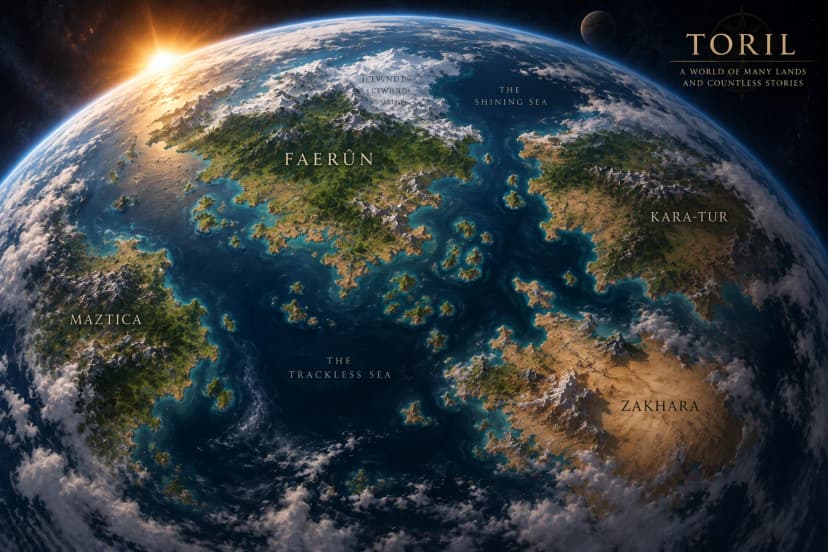
We began with Toril, the world itself.
Then Faerûn, the continent at the heart of so many stories.
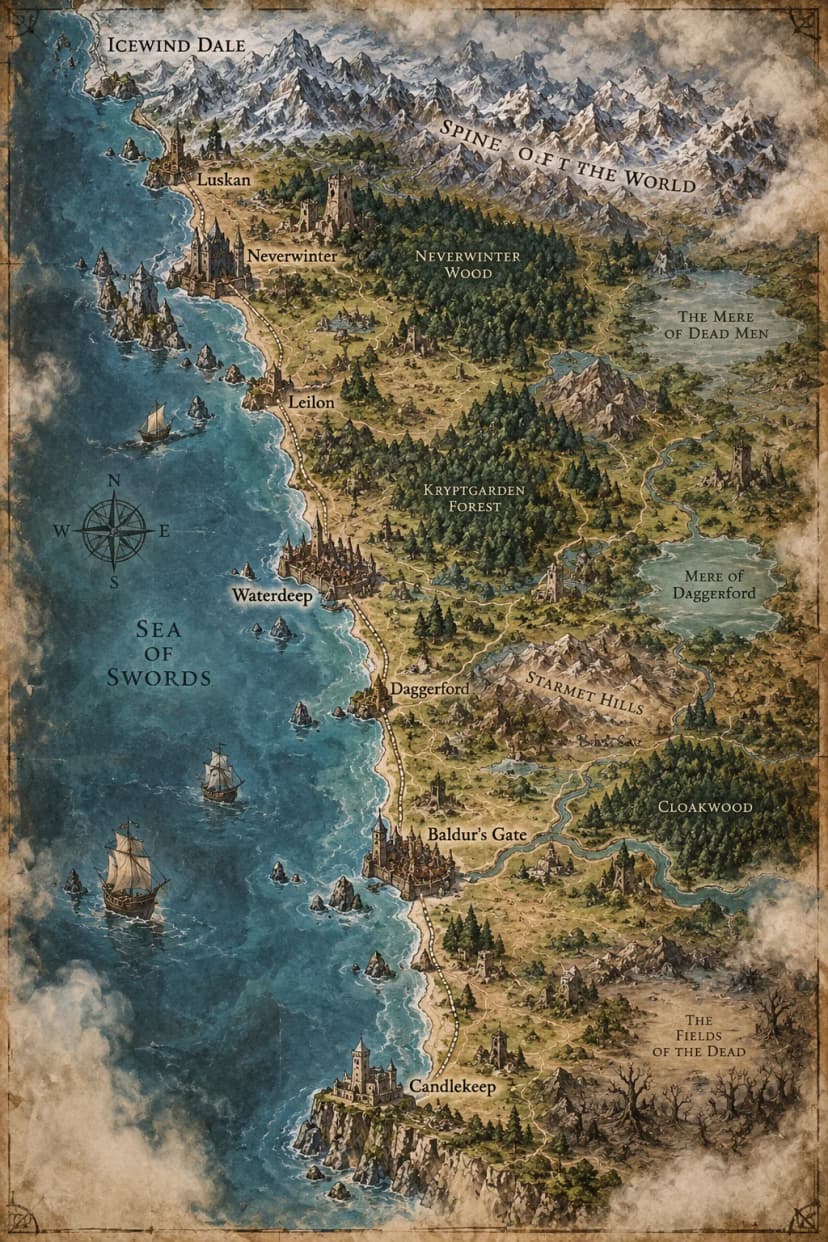
We traveled the Sword Coast, where cities and wilderness exist side by side.
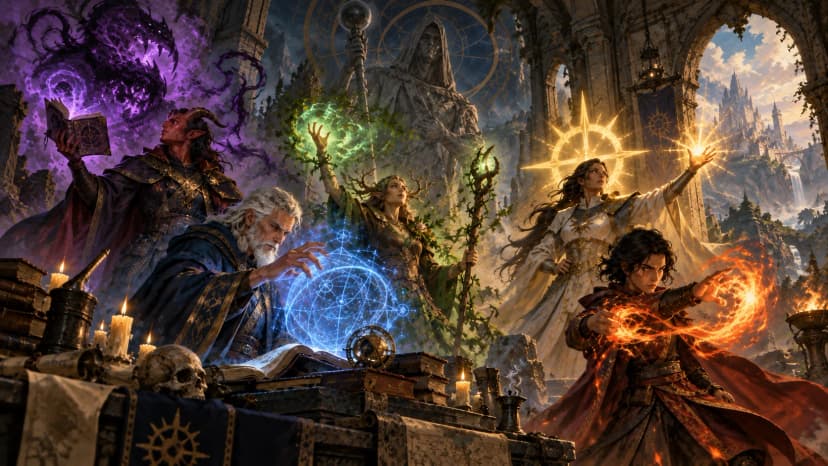
We discovered how magic shapes the world and how spellcasters reach it through the Weave.
And we encountered the gods, whose conflicts can alter mortal history.
Now we know one final thing.
None of these exist in isolation.
They are pieces of a world shaped by tens of thousands of years of stories.
Every kingdom inherited something.
Every ruin belonged to someone.
Every god has enemies.
Every magical discovery has consequences.
And every forgotten story leaves something behind.
So our introduction ends here.
But the history of the Forgotten Realms is only beginning.
Because somewhere beneath the sands of Anauroch lie the remains of an empire whose wizards once raised cities into the sky.
And to understand how magic changed Faerûn forever, we need to return to the age of Netheril.
Sources & Further Reading
- ↩a↩b↩c
Wizards of the Coast, Sword Coast Adventurer’s Guide (2015), chap. 1, “Welcome to the Realms,” especially “A Brief History.” The official guide establishes the immense depth of Faerûn’s history and provides an overview of the ancient peoples, fallen realms, migrations, conflicts, and catastrophes that shaped the modern Sword Coast and wider Realms.
Sword Coast Adventurer's Guide — D&D Beyond - ↩
Wizards of the Coast, Forgotten Realms: Heroes of Faerûn (2025), chap. 2, “A Guide to the Realms,” especially “Arcane Empires.” The current Forgotten Realms sourcebook explicitly identifies the ancient arcane empires as part of the historical foundation of modern Faerûn.
Forgotten Realms: Heroes of Faerûn — D&D Beyond - ↩
Wizards of the Coast, Sword Coast Adventurer’s Guide, “A Brief History,” together with the current treatment of Faerûn’s arcane empires in Forgotten Realms: Heroes of Faerûn. Netheril’s extraordinary magical civilization and catastrophic fall form one of the major ancient legacies underlying the modern Realms.
- ↩a↩b
Wizards of the Coast, Sword Coast Adventurer’s Guide, “A Brief History.” The Time of Troubles occurred in 1358 DR and brought divine upheaval directly into the mortal world, leaving lasting changes to Faerûn’s gods and magic.
- ↩a↩b
Wizards of the Coast, Sword Coast Adventurer’s Guide, “A Brief History” and “Magic in the Realms.” The Spellplague began in 1385 DR following Mystra’s death and produced enormous magical and geographical upheaval across the Realms. The continuing significance of the Spellplague and rebuilding of the Weave is also reflected in Wizards’ current Forgotten Realms material.
- ↩
Wizards of the Coast, Sword Coast Adventurer’s Guide, “A Brief History.” The Second Sundering describes the later period of upheaval during which many of the geographical and divine changes associated with the previous century were altered again, establishing the broad shape of the modern Realms.
Bibliography
- Wizards of the Coast. Forgotten Realms: Heroes of Faerûn. Renton, WA: Wizards of the Coast, 2025. Especially chap. 2, “A Guide to the Realms,” including “Arcane Empires.”
Forgotten Realms: Heroes of Faerûn — D&D Beyond - Wizards of the Coast. Sword Coast Adventurer’s Guide. Renton, WA: Wizards of the Coast, 2015. Especially chap. 1, “Welcome to the Realms”: “A Brief History,” “Magic in the Realms,” and “Religion in the Realms.”
Sword Coast Adventurer's Guide — D&D Beyond