How Magic Works in the Forgotten Realms
Discover how magic flows through the Forgotten Realms, the different paths spellcasters use to wield it, and how it has shaped the history of Faerûn.
 G.R. Vinces6 min read
Welcome to the Forgotten Realms · Reading 5 of 8
In the Forgotten Realms, magic isn’t something that exists only inside ancient ruins or in the hands of legendary wizards.
It is part of the world.
Magic can heal wounds, reveal hidden truths, summon creatures, transform matter, influence minds, open passages across impossible distances, and—in the hands of the exceptionally powerful—even return the dead to life.1
Entire civilizations have risen because of it.
Others have fallen because they believed they understood it.
But before we can understand those stories, we need to answer a deceptively simple question:
What exactly is magic?
Magic Is Everywhere
At the most fundamental level, the D&D multiverse is suffused with magical power.1
That power exists throughout creation, but possessing magical energy and being able to shape it are different things.
A spellcaster doesn’t simply reach into the air and grab raw magic.
Instead, magic is given structure.
A spell is essentially a controlled magical effect: magical energy shaped into a particular pattern to accomplish something specific.1
The result might be a tiny light floating above someone’s hand.
Or an illusion.
Or a bolt of lightning.
Or a doorway connecting two distant places.
The difference isn’t necessarily where the magic comes from.
It’s how someone learns to reach it and shape it.
There Is More Than One Path to Magic
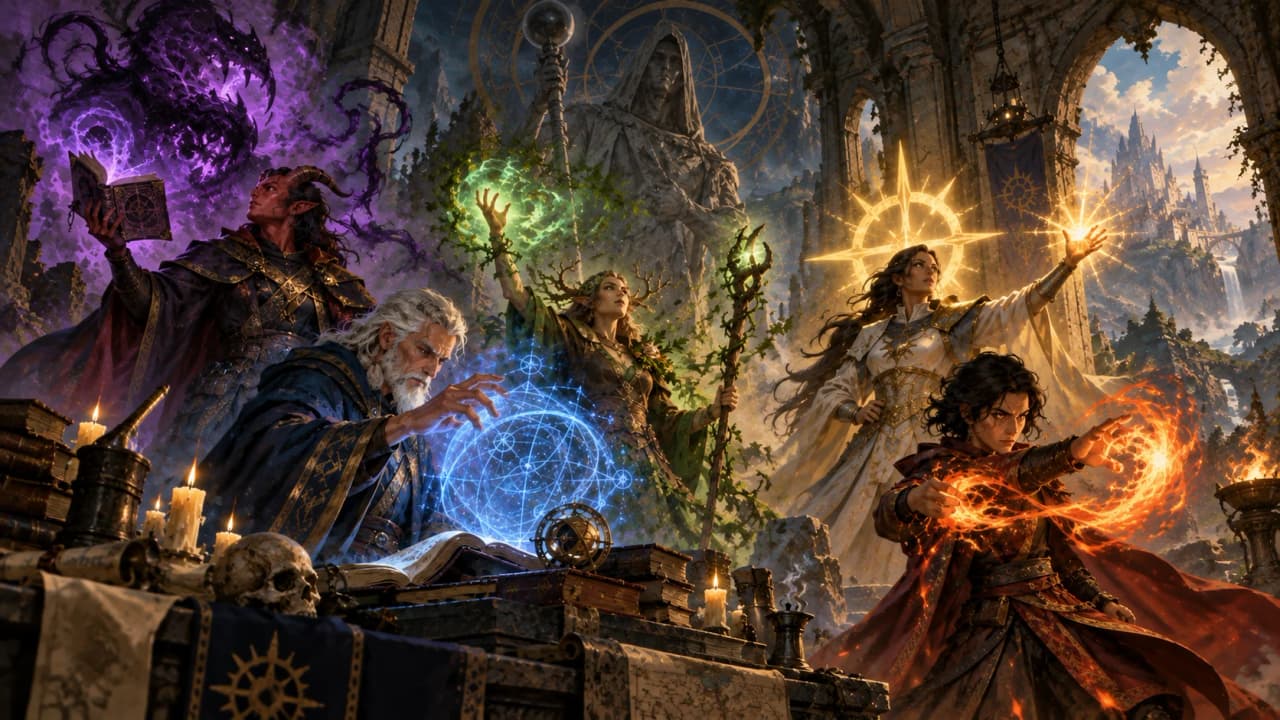
Not every spellcaster understands magic the same way.
A wizard approaches magic through study. Years can be spent learning spells, recording them in spellbooks, experimenting with magical principles, and developing an intellectual understanding of how magic behaves.2
A sorcerer, by contrast, possesses magic intrinsically. Their supernatural power might arise from an extraordinary lineage, magical influence, or another source that has made magic part of who they are.3
A warlock gains supernatural abilities through a relationship with an otherworldly patron.4
Bards use their own traditions of magical knowledge and expression.
And then there are those whose magic is associated with divine or sacred power.
Clerics draw upon divine power through prayer and devotion, while other traditions connect magical abilities to nature, sacred oaths, or other supernatural sources.5
These traditions can look radically different.
A wizard studying a spellbook and a cleric praying in a temple may have completely different explanations for what they are doing.
Yet both can produce genuine magic.
In the Forgotten Realms, these traditions are commonly grouped into broad categories such as arcane and divine magic.6
But underneath them lies something deeper.
Magic Can Be Studied
Over thousands of years, spellcasters have developed ways to understand and categorize magical effects.
One of the most familiar systems divides spells into eight schools of magic:
Abjuration protects and counters harmful effects.
Conjuration summons or transports.
Divination reveals information.
Enchantment influences minds.
Evocation channels energy.
Illusion deceives perception.
Necromancy manipulates forces associated with life and death.
Transmutation transforms creatures and objects.7
These aren’t eight separate sources of magical power.
They’re ways of describing what magic does.
That distinction matters.
Because magic in the Forgotten Realms isn’t merely mysterious.
People have spent centuries trying to understand it.
And sometimes they have become frighteningly good at it.
Magic Built Civilizations
Nowhere is that more obvious than in the history of Faerûn.
Ancient magical civilizations pushed spellcraft far beyond what most people encounter in everyday life.
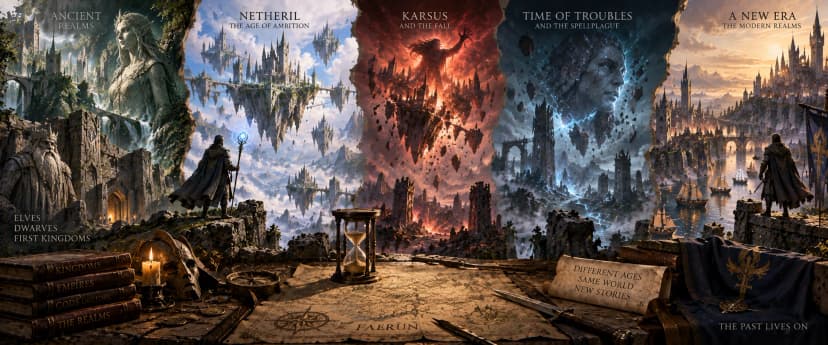
The most famous example is Netheril, whose arcanists achieved extraordinary feats of magic and created flying enclaves—settlements lifted into the sky through powerful arcane workings.8
Magic wasn’t simply a weapon or profession to them.
It became part of civilization itself.
And Netheril was not the only culture shaped by magical knowledge. Across Faerûn, magical traditions, artifacts, institutions, creatures, and catastrophes have left their marks on the landscape and its history.9
That legacy is one reason ruins are so dangerous.
An ancient ruin isn’t necessarily just an abandoned building.
It might be an abandoned magical experiment.
Magic Has Limits
For all its power, magic isn’t limitless.
Spells require knowledge, ability, and often specific words, gestures, or materials. More powerful magical effects demand increasingly capable spellcasters.1
Magic can also be disrupted.
Spells can be countered or dispelled. Areas can exist where magic behaves differently. And the history of the Forgotten Realms contains moments when disruptions to magic had consequences across enormous portions of the world.6
That tells us something important.
Magic may permeate the Realms.
But the ability to use it depends upon something.
Something that exists between the spellcaster and the raw magical power suffusing creation.
Wizards study it.
Sorcerers intuitively interact with it.
Divine spellcasters reach it through other forms of power.
And when it is damaged, magic itself can become unpredictable—or disappear entirely.6
The people of Faerûn have a name for this invisible structure.
The Weave.
Sources & Further Reading
- ↩a↩b↩c↩d
Wizards of the Coast, Dungeons & Dragons Basic Rules (2014), chap. 10, “Spellcasting,” especially “What Is a Spell?” and “The Weave of Magic.” The rules describe magic as permeating D&D’s worlds and spells as particular shapings of magical energy; they also establish the range of effects magic can produce.
D&D Basic Rules — Spellcasting - ↩
Wizards of the Coast, D&D Basic Rules (2024), “Character Classes: Wizard.” The current Wizard description explicitly grounds wizardly spellcasting in extensive study of magic and the use of a spellbook.
D&D Basic Rules — Character Classes - ↩
Wizards of the Coast, Dungeons & Dragons Basic Rules (2014), “Sorcerer.” The sorcerer’s spellcasting ability originates from an innate or inherited source of arcane magic rather than wizardly study.
D&D Beyond — Basic Rules - ↩
Wizards of the Coast, Player’s Handbook (2024), “Warlock.” Warlocks derive magical capabilities from their relationship with supernatural patrons. This Reading mentions that distinction only to illustrate that spellcasters can gain access to magic through fundamentally different traditions.
- ↩
Wizards of the Coast, D&D Basic Rules (2024), “Character Classes: Cleric.” The Cleric class describes spellcasting through prayer and meditation and explicitly describes Channel Divinity as drawing divine energy from the Outer Planes.
D&D Basic Rules — Character Classes - ↩a↩b↩c
Wizards of the Coast, Sword Coast Adventurer’s Guide (Renton, WA: Wizards of the Coast, 2015), chap. 1, “Magic in the Realms”; Wizards of the Coast, Forgotten Realms: Heroes of Faerûn (Renton, WA: Wizards of the Coast, 2025), chap. 3, “Divine Magic,” and chap. 5, “Magic of Faerûn,” especially “The Weave.” The current Forgotten Realms guide treats divine magic and the Weave separately while placing both within Faerûn’s broader magical traditions.
Forgotten Realms: Heroes of Faerûn
Sword Coast Adventurer's Guide - ↩
Wizards of the Coast, D&D Basic Rules (2024), “Spells: School of Magic.” The current rules recognize eight schools—Abjuration, Conjuration, Divination, Enchantment, Evocation, Illusion, Necromancy, and Transmutation—and describe the typical effects associated with each.
D&D Basic Rules — Spells - ↩
Wizards of the Coast, Forgotten Realms: Heroes of Faerûn, chap. 2, “A Guide to the Realms,” especially “Arcane Empires,” and chap. 5, “Magic of Faerûn.” These sections provide current setting context for Faerûn’s great magical civilizations and their legacies.
Forgotten Realms: Heroes of Faerûn - ↩
Wizards of the Coast, Sword Coast Adventurer’s Guide, chap. 1, “A Brief History” and “Magic in the Realms”; Wizards of the Coast, Forgotten Realms: Heroes of Faerûn, chaps. 2 and 5. Together these sources establish magic as a recurring force in Faerûn’s civilizations, historical events, and regional identities.
Sword Coast Adventurer's Guide
Bibliography
- Wizards of the Coast. D&D Basic Rules. 2024. Especially “Character Classes” and “Spells.”
D&D Basic Rules — Character Classes
D&D Basic Rules — Spells - Wizards of the Coast. Dungeons & Dragons Basic Rules. 2014. Especially chap. 10, “Spellcasting,” including “The Weave of Magic.”
D&D Basic Rules (2014) — Spellcasting - Wizards of the Coast. Forgotten Realms: Heroes of Faerûn. Renton, WA: Wizards of the Coast, 2025. Especially chap. 3, “Gods of Faerûn,” and chap. 5, “Magic of Faerûn.”
Forgotten Realms: Heroes of Faerûn — D&D Beyond - Wizards of the Coast. Player’s Handbook. Renton, WA: Wizards of the Coast, 2024.
- Wizards of the Coast. Sword Coast Adventurer’s Guide. Renton, WA: Wizards of the Coast, 2015. Especially chap. 1, “Magic in the Realms.”
Sword Coast Adventurer's Guide — D&D Beyond