The Gods of the Forgotten Realms
Discover the gods of Faerûn, how mortals worship them, and why divine power is an undeniable force in the Forgotten Realms.
 G.R. Vinces5 min read
Welcome to the Forgotten Realms · Reading 7 of 8
In many worlds, people argue about whether the gods exist.
In the Forgotten Realms, that’s a much harder argument to make.
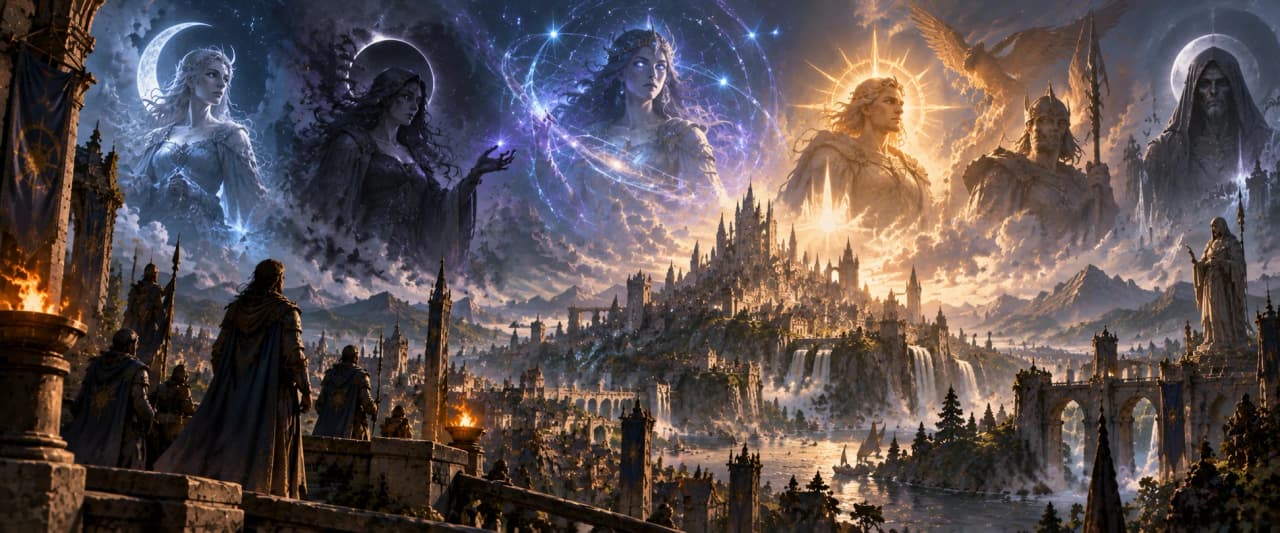
The gods of Faerûn are not merely characters in ancient stories. Their priests wield divine power. Their temples stand throughout the world. Their servants act in their names. Their influence reaches into magic, nature, war, death, knowledge, and countless other aspects of mortal existence.1
There are dozens of widely known deities in the Realms, with still more worshiped by particular cultures, communities, and traditions.2
For the people of Faerûn, the question usually isn’t:
“Are the gods real?”
It’s:
“Which gods should I be worried about today?”
Gods Have Domains
The gods of Faerûn are associated with different aspects of existence, often called their portfolios.
Mystra is the goddess of magic.
Selûne is associated with the moon.
Shar with darkness and loss.
Lathander with dawn and renewal.
Tyr with justice.
Tempus with war.
Kelemvor with the dead.2
These associations help explain why different people turn to different gods.
A sailor preparing for a dangerous voyage may have different concerns from a farmer praying for a successful harvest.
A soldier approaching battle might invoke a god of war.
Someone mourning the dead might seek comfort from a deity associated with death or the passage into the afterlife.
Religion in Faerûn is woven into everyday life precisely because the gods represent forces that people encounter every day.
Most People Don’t Worship Just One God
This creates a religious culture that can feel very different from many modern traditions.
A person in the Forgotten Realms might honor several gods during the same day.
Official D&D material gives a wonderfully ordinary example: someone might pray to Sune concerning love, make an offering to Waukeen before visiting the market, and seek to appease Talos when a dangerous storm approaches.3
That doesn’t necessarily mean those gods are equally important to that person.
Many people favor a particular deity whose teachings or ideals resonate with them. Priests and champions may devote their lives to one god.
But everyday worship can be practical.
The gods govern different parts of existence.
So mortals learn which gods matter when.
Faith Can Produce Real Power
For some people, the relationship becomes much deeper.
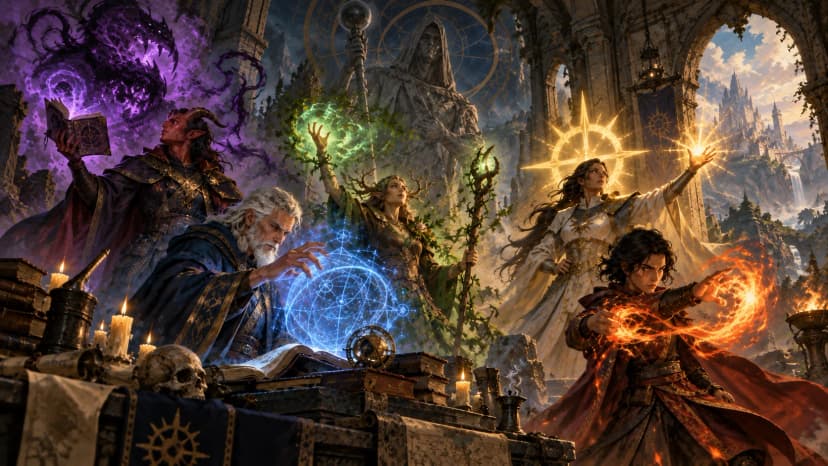
Clerics can wield divine magic.
Through devotion, prayer, and service, they become conduits for supernatural power associated with the divine.4
That makes religion more than philosophy.
A priest might preach about the mercy of their god.
A cleric might demonstrate that faith by healing someone who should have died.
Divine power doesn’t mean every priest can perform miracles, nor does every religious institution necessarily possess extraordinary magic. But the existence of divine spellcasters makes the supernatural reality behind religion extraordinarily difficult to ignore.
The gods can also influence the world through their churches, chosen servants, sacred orders, omens, supernatural agents, and other followers.1
Their conflicts therefore don’t remain confined to distant divine realms.
Mortals become part of them.
The Gods Don’t Always Agree
And the gods have enemies.
Some divine rivalries are ancient.
Selûne and Shar represent opposing cosmic forces and are among the most famous divine adversaries in the Realms. Other gods compete over beliefs, followers, influence, or conflicting visions of how the world should work.5
Those rivalries can spill into Faerûn through temples, cults, champions, and factions.
A conflict between gods can become a conflict between nations.
Or churches.
Or two people standing in a dungeon with very different holy symbols around their necks.
This makes religion another source of politics in the Forgotten Realms.
Except the political figures involved may be immortal.
Even Gods Have Histories
Perhaps the strangest thing about the gods of Faerûn is that divinity does not place them outside history.
Gods have risen and fallen.
Divine identities and portfolios have changed hands.
And at different points in the history of the Realms, divine upheavals have directly affected the mortal world.1
This means the pantheon isn’t simply a permanent list of eternal beings who have always existed exactly as they do now.
It has a history.
Mystra is a particularly important example. Her connection to the Weave means that upheaval surrounding the goddess of magic can have consequences for magic itself.
Other gods have their own stories of conflict, transformation, death, succession, and return.
Some of those stories changed Faerûn forever.
The Gods Are Part of the World
This is one of the defining characteristics of the Forgotten Realms.
Magic has a goddess.
Death has a god.
The moon has a goddess.
Storms, knowledge, justice, war, nature, trade, and countless other parts of existence are intertwined with divine powers that mortals worship, fear, bargain with, and sometimes oppose.
Yet most people will never stand face-to-face with a god.
They experience the divine indirectly.
Through a temple bell.
A cleric’s prayer.
An offering left before a voyage.
A holy symbol carried into battle.
Or perhaps a miracle at precisely the moment one was desperately needed.
The gods may exist beyond the mortal world.
But their stories are inseparable from it.
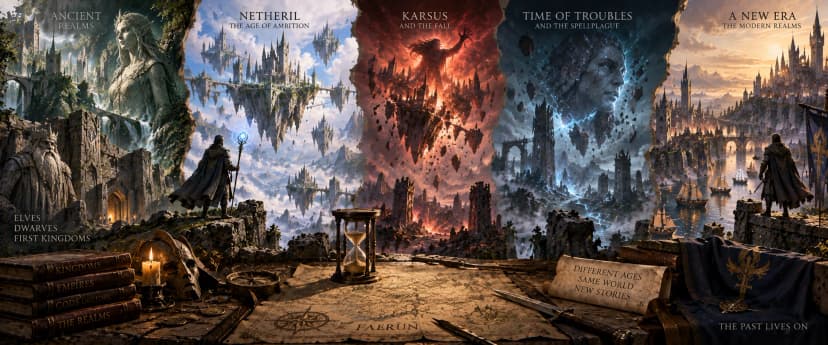
And once gods can rise and fall, magical civilizations can destroy themselves, and kingdoms can disappear into history, understanding Faerûn requires looking backward.
Because the world we’ve been exploring was built upon thousands of years of everything that came before it.
Sources & Further Reading
- ↩a↩b↩c
Wizards of the Coast, Forgotten Realms: Heroes of Faerûn (2025), chap. 3, “Gods of Faerûn.” The current Forgotten Realms sourcebook dedicates sections to forms of worship, the afterlife, religious institutions, divine magic, and the deities of Faerûn, making it the principal current source for religion in the setting.
Forgotten Realms: Heroes of Faerûn — D&D Beyond - ↩a↩b
Wizards of the Coast, Dungeons & Dragons Basic Rules (2014), appendix B, “Gods of the Multiverse.” The Forgotten Realms pantheon includes dozens of widely recognized gods as well as additional deities worshiped by local cultures, sects, and communities. The appendix identifies the portfolios and symbols of major Realms deities.
D&D Basic Rules — Gods of the Multiverse - ↩
Dungeons & Dragons Basic Rules, appendix B. The source explicitly describes Forgotten Realms worship as involving different gods according to circumstance, using Sune, Waukeen, and Talos as examples.
- ↩
Wizards of the Coast, Dungeons & Dragons Basic Rules (2014), “Cleric”; Forgotten Realms: Heroes of Faerûn (2025), chap. 3, “Divine Magic.” Clerics are closely associated with divine service and supernatural power, while the current Realms sourcebook separately addresses the setting’s divine magic.
D&D Basic Rules — Classes - ↩
Wizards of the Coast, Forgotten Realms: Heroes of Faerûn (2025), chap. 3, “Gods of Faerûn,” for the current treatment of Faerûn’s deities and their relationships.
Bibliography
- Wizards of the Coast. Forgotten Realms: Heroes of Faerûn. Renton, WA: Wizards of the Coast, 2025. Especially chap. 3, “Gods of Faerûn.”
Forgotten Realms: Heroes of Faerûn — D&D Beyond - Wizards of the Coast. Dungeons & Dragons Basic Rules. 2014. Especially appendix B, “Gods of the Multiverse,” and the Cleric class.
D&D Basic Rules — Gods of the Multiverse